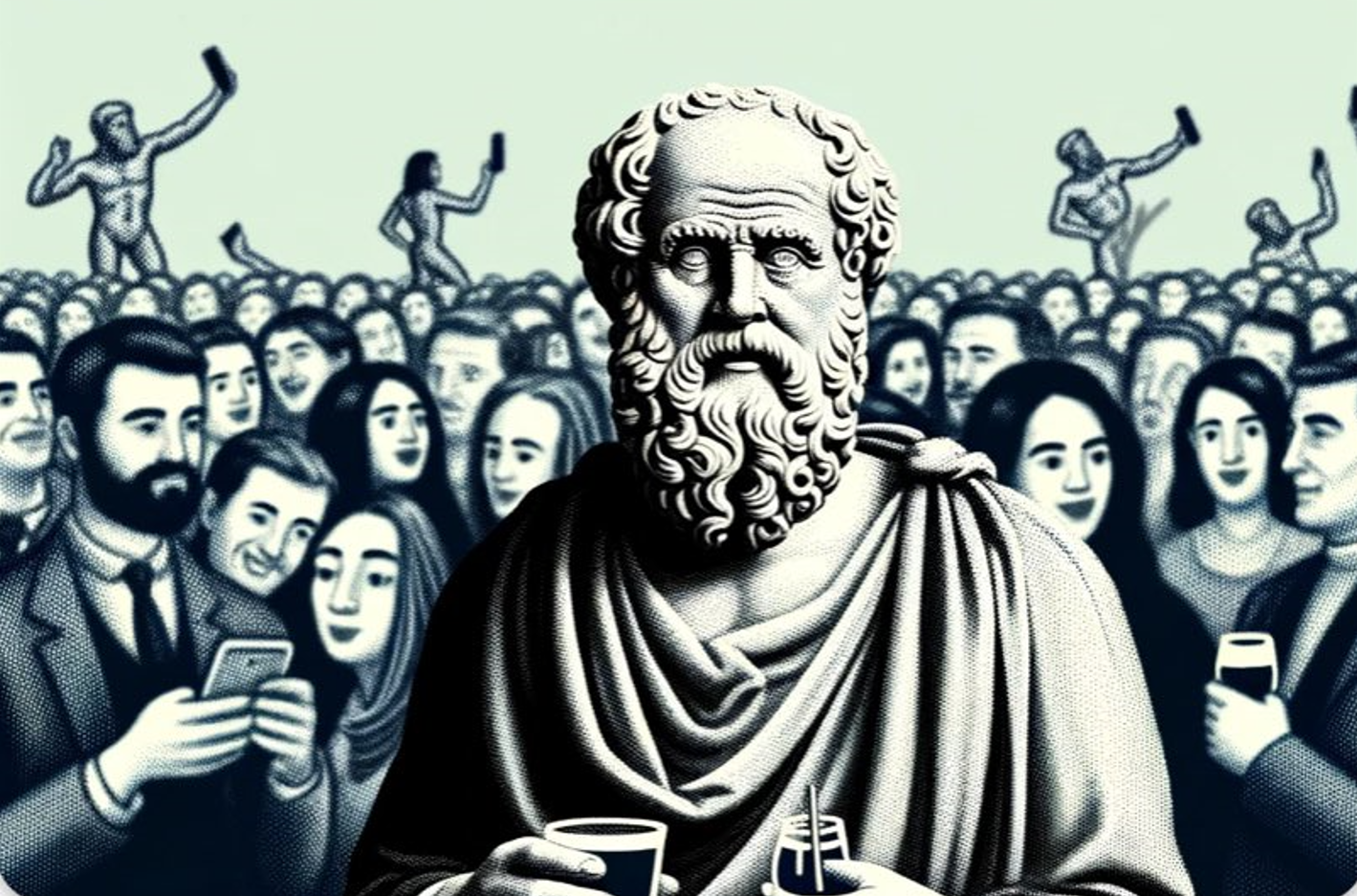
AI-generated image inspired by "Your Friends & Neighbors". Andrew “Coop” Cooper stands at the center of a crowded party scene, eyes closed and face lifted, absorbed in the moment as colored lights blur behind him. Nick Brandes is visible in the background on the left, and Barney Choi on the right. Text at the top reads, “When dad bought you a ‘Get out of Jail, Free’ card, but you’re just an Internet meme.”

While the “Jon Hamm dancing” meme is definitely taking over the internet, what most struck me about the series is its realistic, fully normalized portrayal of for-profit bail bonds. This genuinely American system allows criminal defendants to “purchase” their freedom in a way that is legally impossible, and culturally condemnable, in most other places.

Read more →

The ‘reply guy’ in me told me that public perception of whether the Gemini name ‘sucks’ or ChatGPT sounds funny is not precisely what keeps Sundar Pichai or Sam Altman up at night right now. Then I thought it was a good chance to showcase Google’s Nano Banana Pro and OpenAI’s GPT Image 1.5, the latest image generation models from the AI giants, and their remarkable, highly improved capabilities to: – Generate highly realistic images of public figures doing mundane tasks in mundane settings. – Produce high-quality marketing copy for virtually any conceivable junk.

Read more →

Read.AI is one of the fastest-growing, most useful genAI productivity tools I’ve tried this year. Built by an award-winning startup, it provides automated meeting transcription, summaries, and real-time analytics by integrating directly into major video conferencing apps, such as Zoom, Teams, and Google Meet. The platform is backed by patented technology that analyzes explicit and implicit participant signals for sharper meeting insights. Beyond high-quality transcripts and useful dashboards, Read.AI recently released “Search Copilot”, an agentic chatbot that leverages info from your transcripts and other productivity tools you may connect, so your meetings never sink into a pile of meeting minutes nobody reads or fade because everyone forgot what was actually said.

Read more →

If you are a professional and consider yourself ‘in need,’ you don’t need a job. You need the salary, plus any other material or immaterial benefits the job provides. Additionally, you may want a particular job that provides them for you. By the way, I made some infographics with Gemini 2.0 Flash native image generation, the new favorite toy in the Gen AI world…

Read more →

Talking to Chatbots is a platform where I share my ideas and thoughts with the world in the form of chatbot conversations and generative AI prompts. Songwriting and music production are likely my favorite generative AI use cases and endless sources of fun. While most music generated by transformer-based models inevitably produces a perception of inexplicable “soullessness” that is behind most of the AI hate and the discourse created around “AI slop,” just as happens with long text produced by LLM inference, some of us enjoy the process of endless iteration and experimentation until we find something we consider unique and representative of our creative ideas and craft. You can find my public music creations on Suno and …

(In the Post-Truth World) I’m Cringe But I’m Free Read more →

Today’s post contains an easy practical use case for multimodal chatbots that I’ve been wanting to test and show here for quite some time, but it still proves we’re far from expecting reliable ‘reasoning’ from LLM tools when incorporating even fairly rudimentary visual elements such as time series charts. I challenged ChatGPT 4o (as discussed in an earlier post, o1 in the web app still does not support image input), Gemini, and Claude to analyze a stacked area chart that visually represents the evolution in the net worth of an individual. After several attempts and blatant hallucinations by all models, I share the best outputs which, as usual in most of the SCBN battles published on Talking to…

Read more →

OpenAI has just released its o1 models. o1 adds a new level of complexity to the traditional architecture of LLMs, a zero-shot chain-of-thought (CoT). I share my first impressions about o1 in the signature style of this website: talking to chatbots, getting their answers, posting everything.

Read more →

Below is the notebook I submitted (late) to the LMSYS – Chatbot Arena Human Preference Predictions competition on Kaggle. This notebook applies NLP techniques for classifying text with popular Python libraries such as scikit-learn and TextBlob, and my own fine-tuned versions of Distilbert. The notebook introduces the first standardized version of SCBN (Specificity, Coherency, Brevity, Novelty) quantitative scores for evaluating chatbot response performance. Additionally, I introduced a new benchmark for classifying prompts named RQTL (Request vs Question, Test vs Learn), which aims to refine human choice predictions and provide context for the SCBN scores based on inferred user intent. You can check all the code, annotations, and charts in the Kaggle widget below. Explore and run the notebook …

Predicting LMSYS Chatbot Arena Votes With the SCBN and RQTL Benchmarks Read more →

We talk so much about ‘papers’ and the presumed authenticity of their content when we read through academic research, in all fields, but when touching on machine learning in particular. Ironically, the process that created the medium for scientific research diffusion in the physical paper era was not that different from the process that produces the ‘content’ in the era governed by machine learning algorithms, whether these are classifiers, search engines, or generative algorithms: ‘shattering’ texts by tokenizing them and creating embeddings, decomposing pieces of visual art into numeric ‘tensors’ a deep artificial neural network will later ‘diffuse’ into images that attract clicks for this cringey blog…

Read more →

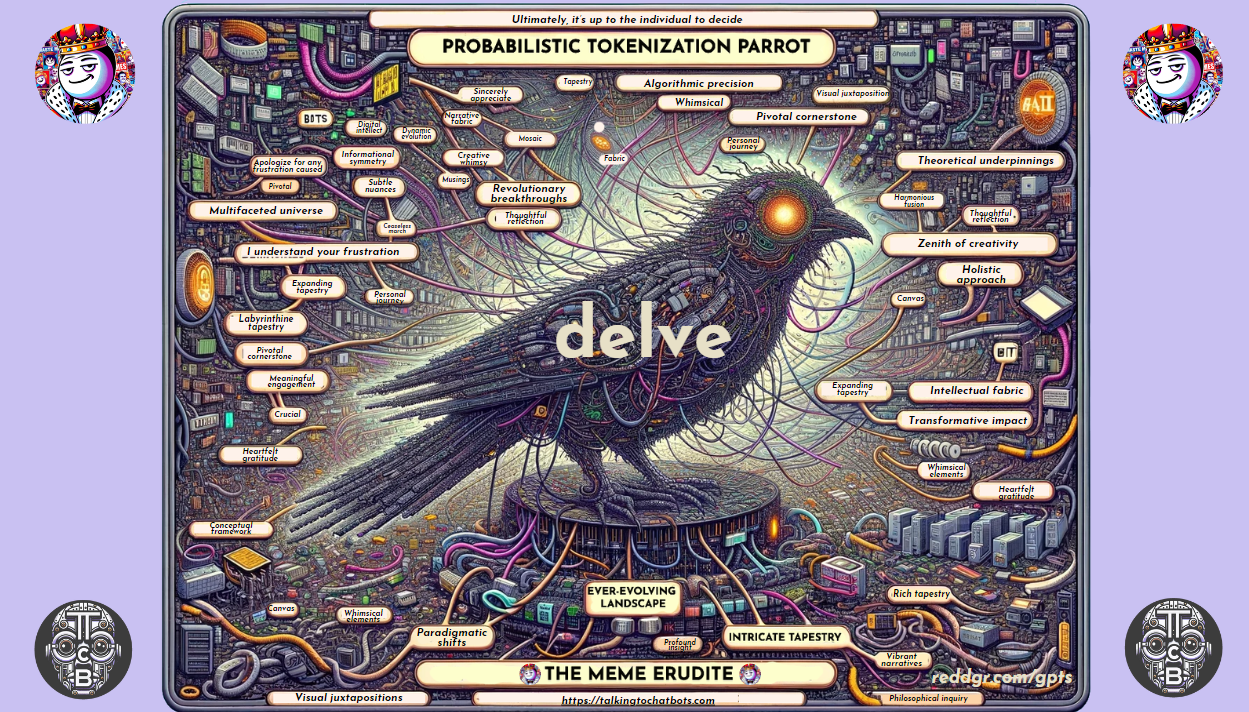
Searching for information is the quintessential misconception about LLMs being helpful or improving other existing technology. In my opinion, web search is a more effective way to find information, simply because search engines give the user what they want faster, and in a format that fits the purpose much better than a chatting tool: multiple sources to scroll through in a purpose-built user interface, including filter options, configuration settings, listed elements, excerpts, tabulated results, whatever you get in that particular web search tool… not the “I’m here to assist you, let’s delve into the intricacies of the ever-evolving landscape of X…” followed by a long perfectly composed paragraph based on a probabilistic model you would typically get when you…

Read more →