Gemini as a name sucks. Google should have Google Chat just like it previously had Google Search.
@burkov on 𝕏
I came across this opinionated post by Andriy Burkov on 𝕏, the content platform where any niche discussion can be amplified to the category of existential debate, thanks to the magic of its algorithm, and the selfless collaboration of reply guys like me.
The replies to Burkov’s criticism of Google’s branding choice presented other famous AI names that some people think ‘suck’, such as ChatGPT (“the name is awful”), along with Google’s previous Bard (“i guess you don’t remember the BARD then”) and the brand new Nano Banana (“you’ll appreciate Gemini is a better name”).
That said, the ‘reply guy’ in me told me that public perception of whether the Gemini name ‘sucks’ or ChatGPT sounds funny is not precisely what keeps Sundar Pichai or Sam Altman, Google and OpenAI CEOs, up at night right now. Then I thought it was a good chance to showcase Google’s Nano Banana Pro and OpenAI’s GPT Image 1.5, the latest image generation models from the AI giants, and their remarkable, highly improved capabilities to:
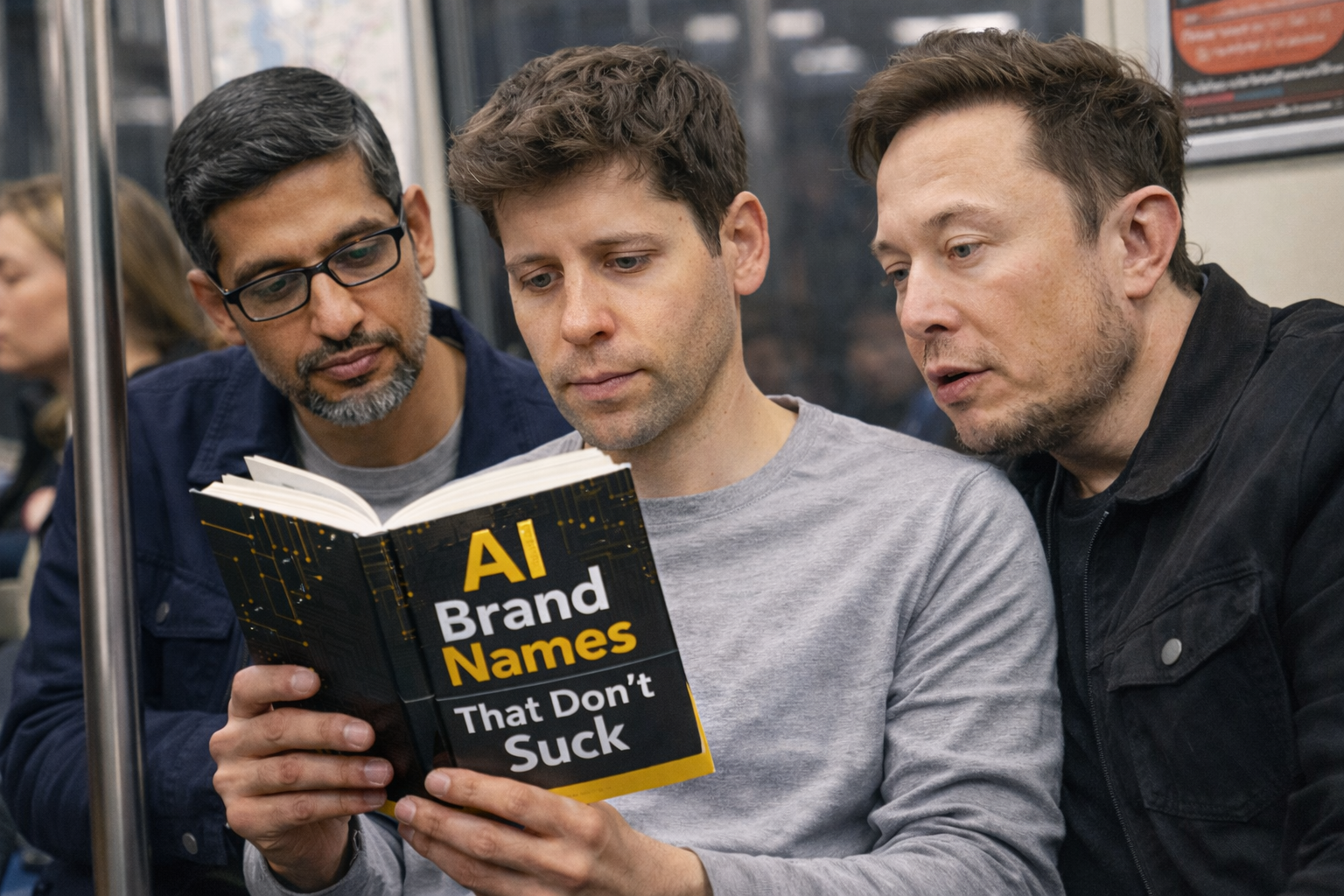
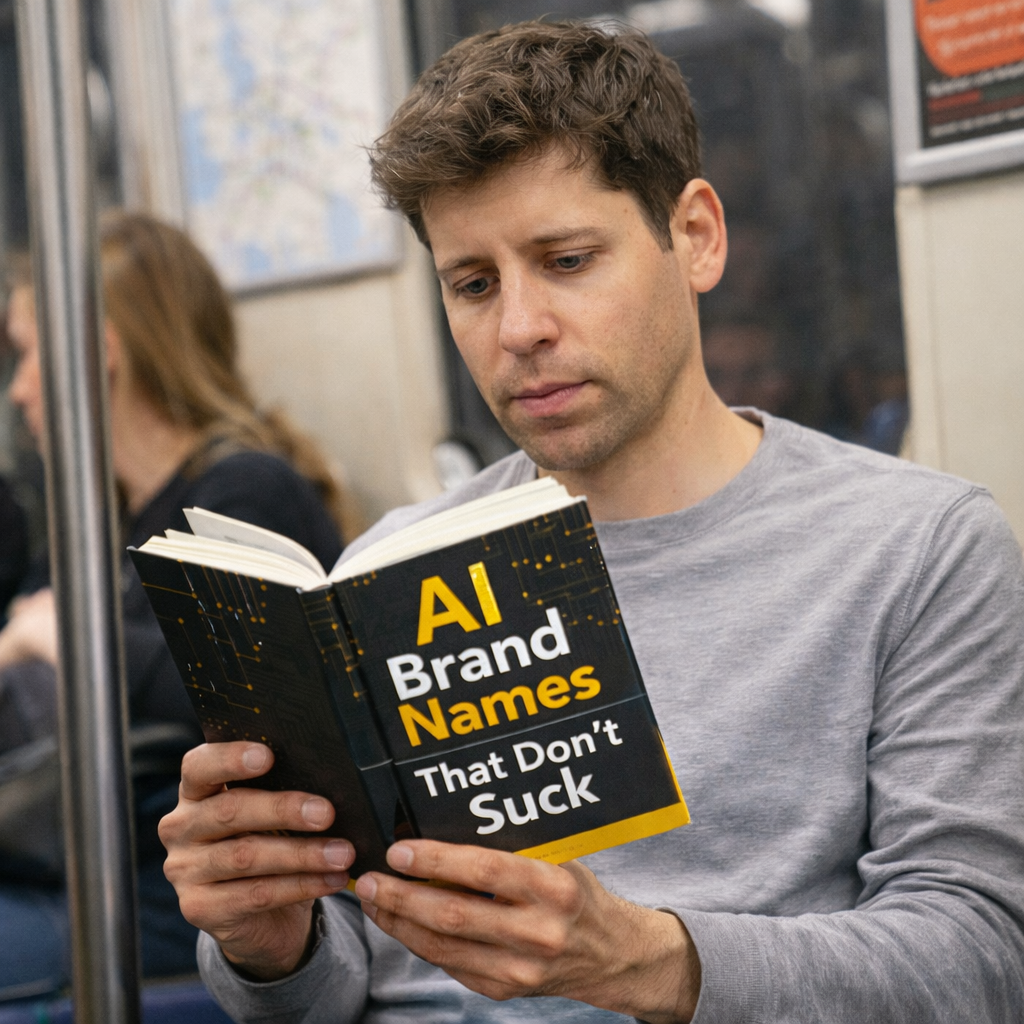
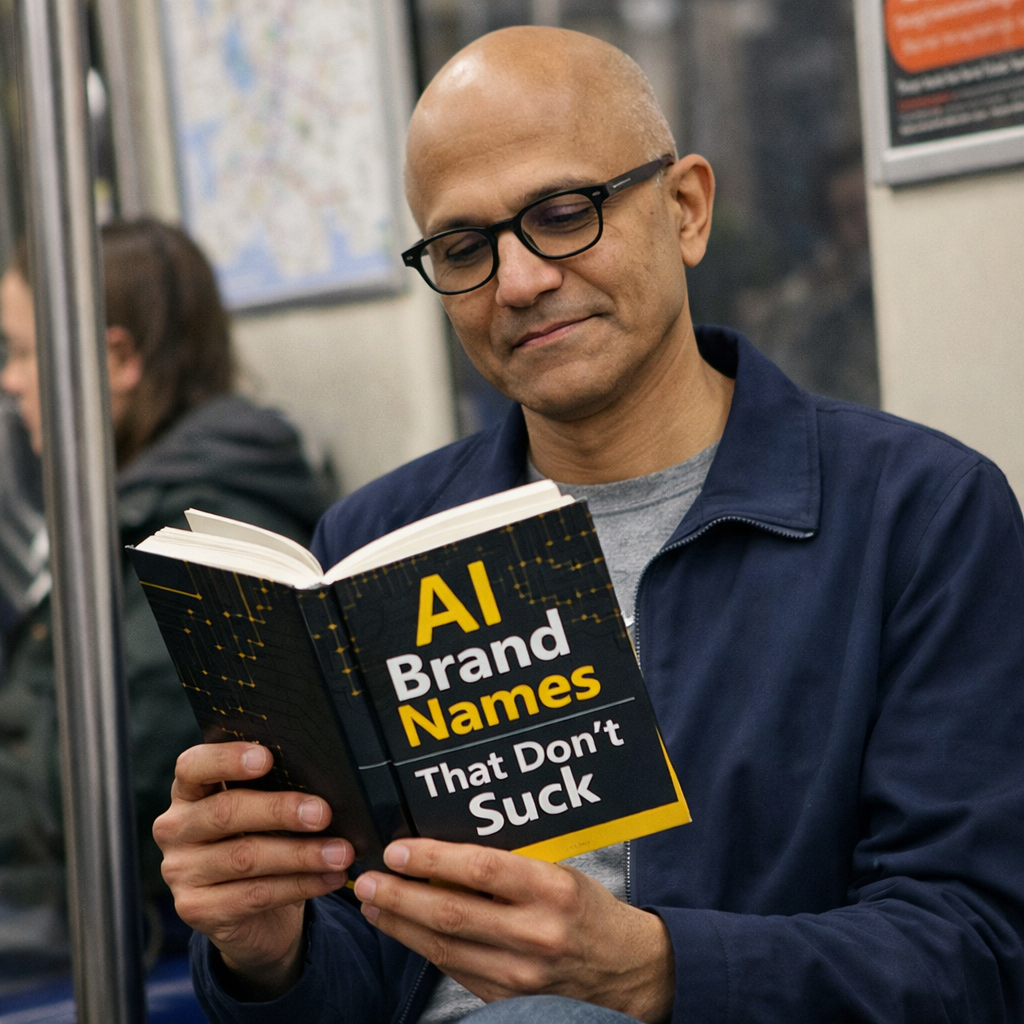
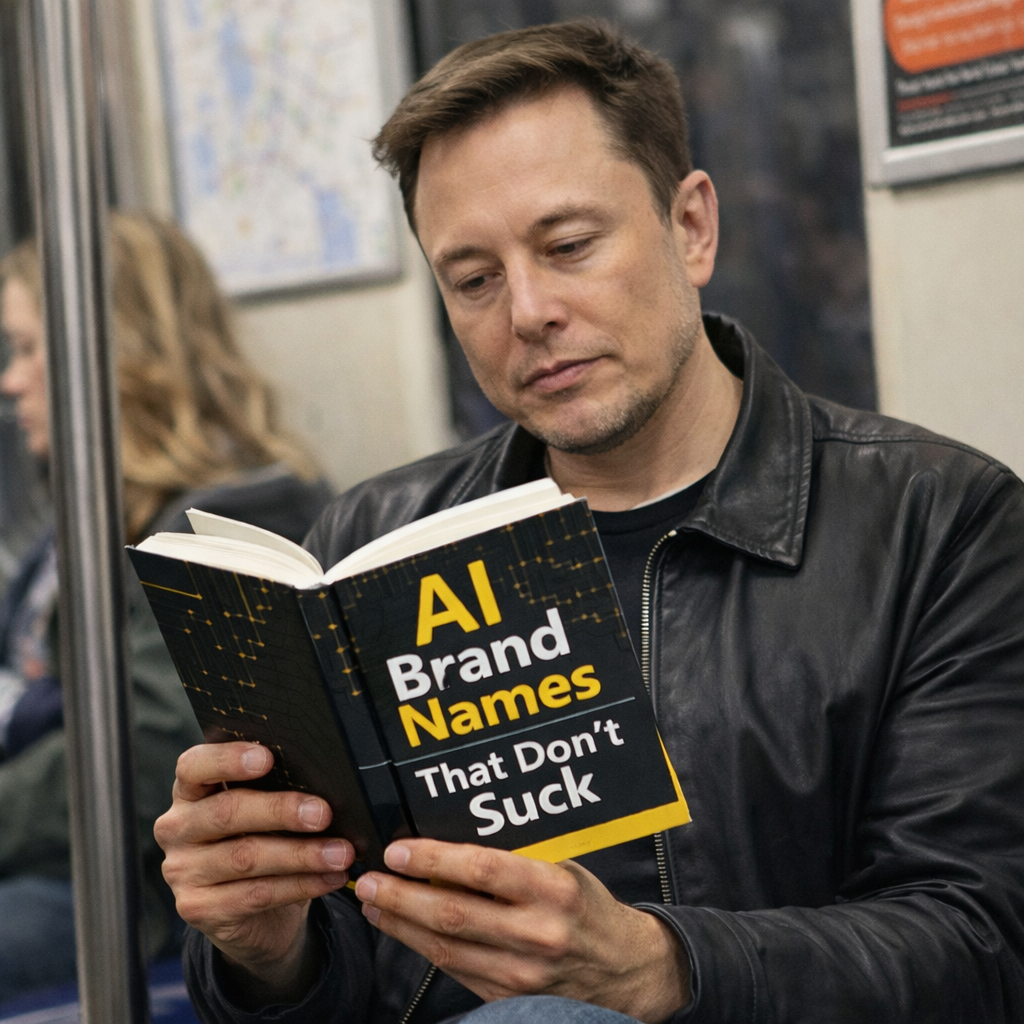
Generate highly realistic images of public figures doing mundane tasks in mundane settings:
Produce high-quality marketing copy for virtually any conceivable junk
Kind advice to hyperactive authors, founders, and entrepreneurs: please, don’t write the book 🙂
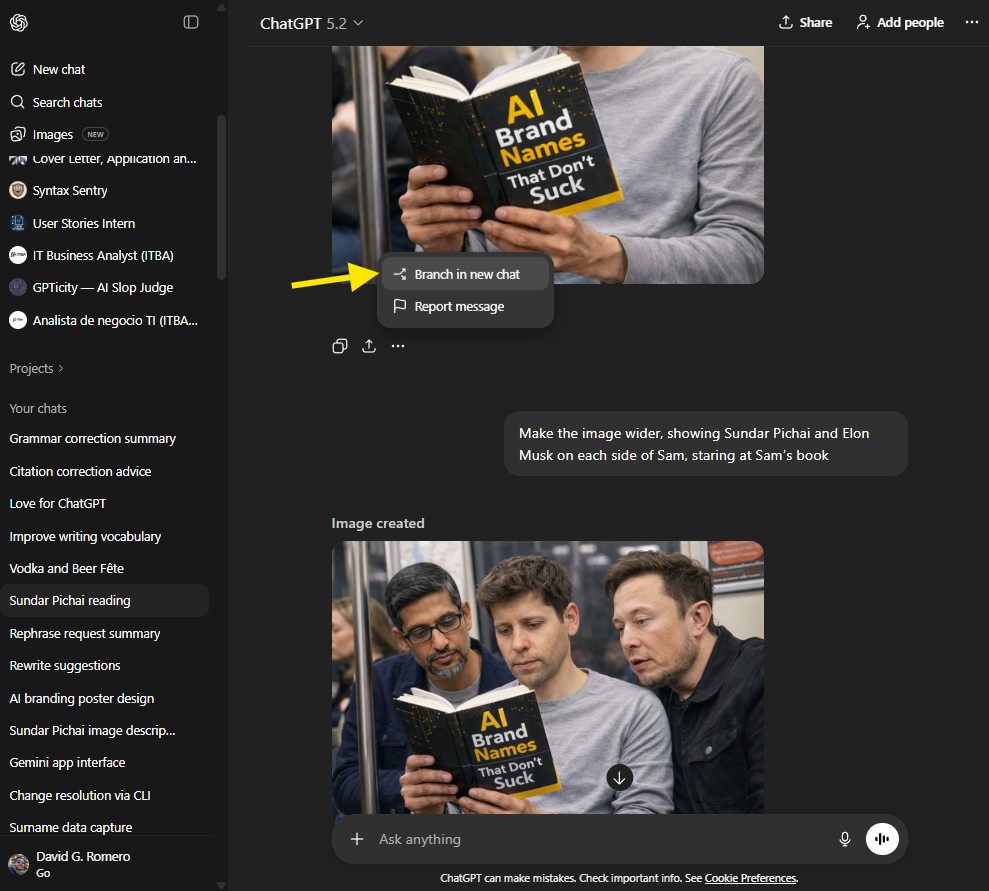
Big Tech Leaders Reading Books in the Subway: ChatGPT Images Playfield
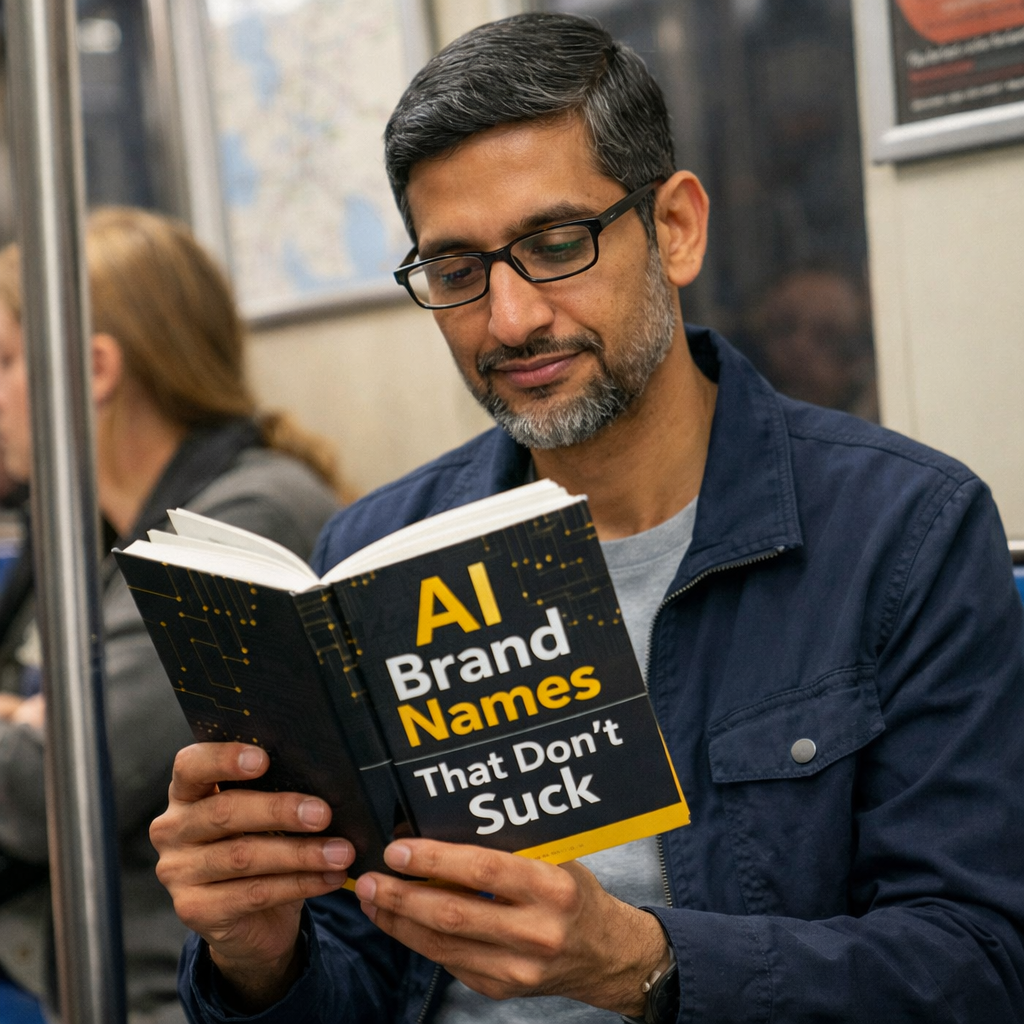
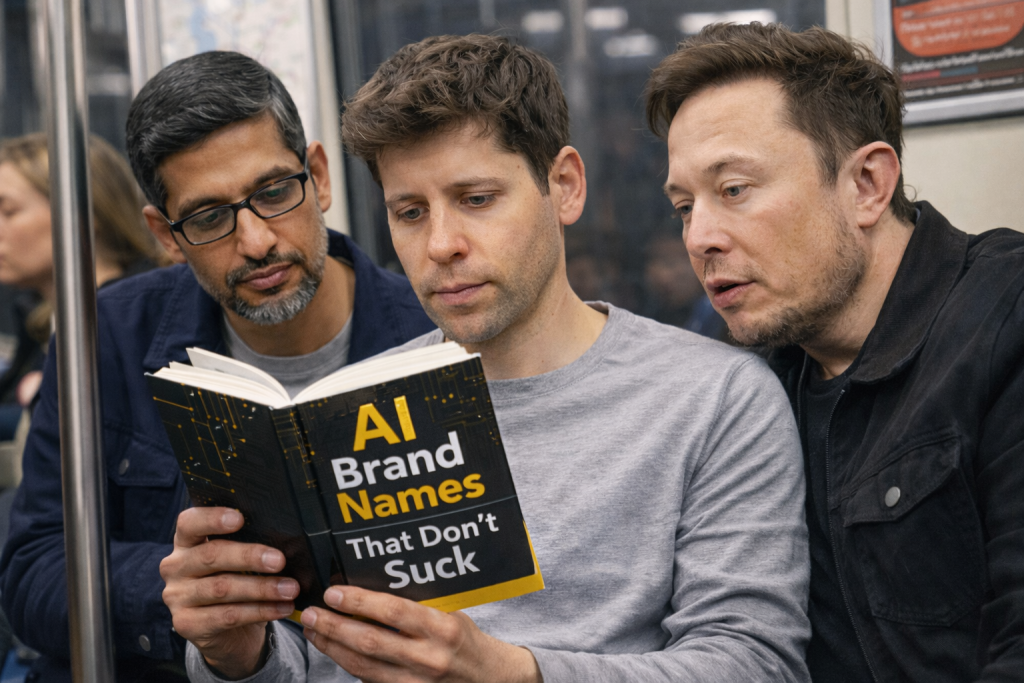
😎 Sam Altman sitting in a subway train, reading a book titled ‘AI brand names that don’t suck’.
😎 Make the image wider, showing Sundar Pichai and Elon Musk on each side of Sam, staring at Sam’s book
✍️ OpenAI and Google have emerged as the two mainstream platforms for AI image generation, the ones that any person, regardless of skill or enthusiasm, can go to for every casual use of gen AI from Facebook AI slop to Ghibli style transfers. The landscape has shifted significantly since the early days of this blog, when OpenAI’s models (then branded DALL·E, which I find a great name) mainly competed with open-source Stable Diffusion (a software executable in our computers, or ‘wrapped’ in websites and community-driven platforms like NightCafé), as well as privately owned Midjourney and Ideogram. Today, Elon Musk’s xAI is also a major contender, propelled by the integration of Grok and Grok Imagine in the 𝕏 platform.
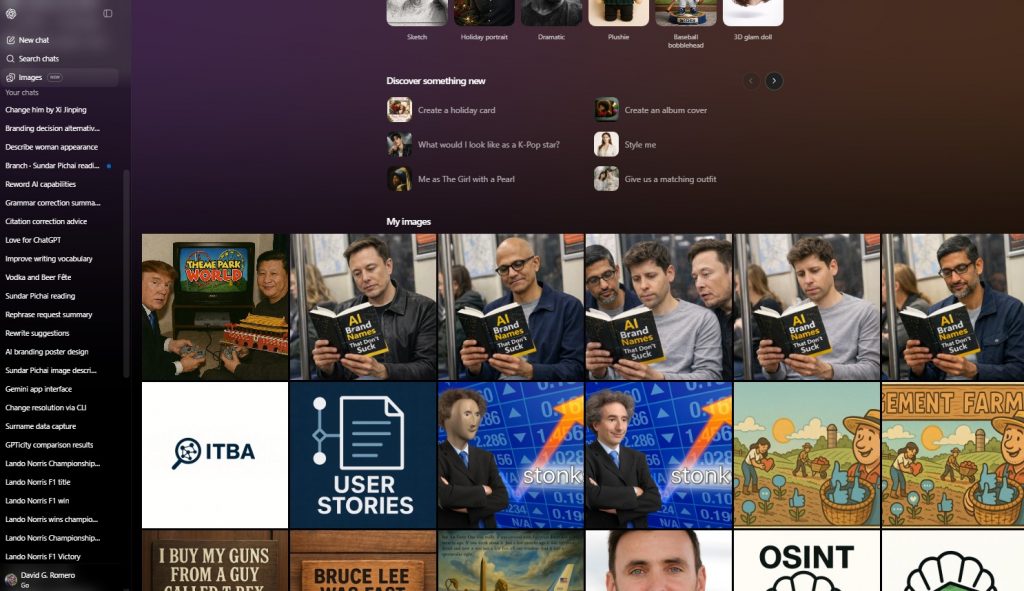
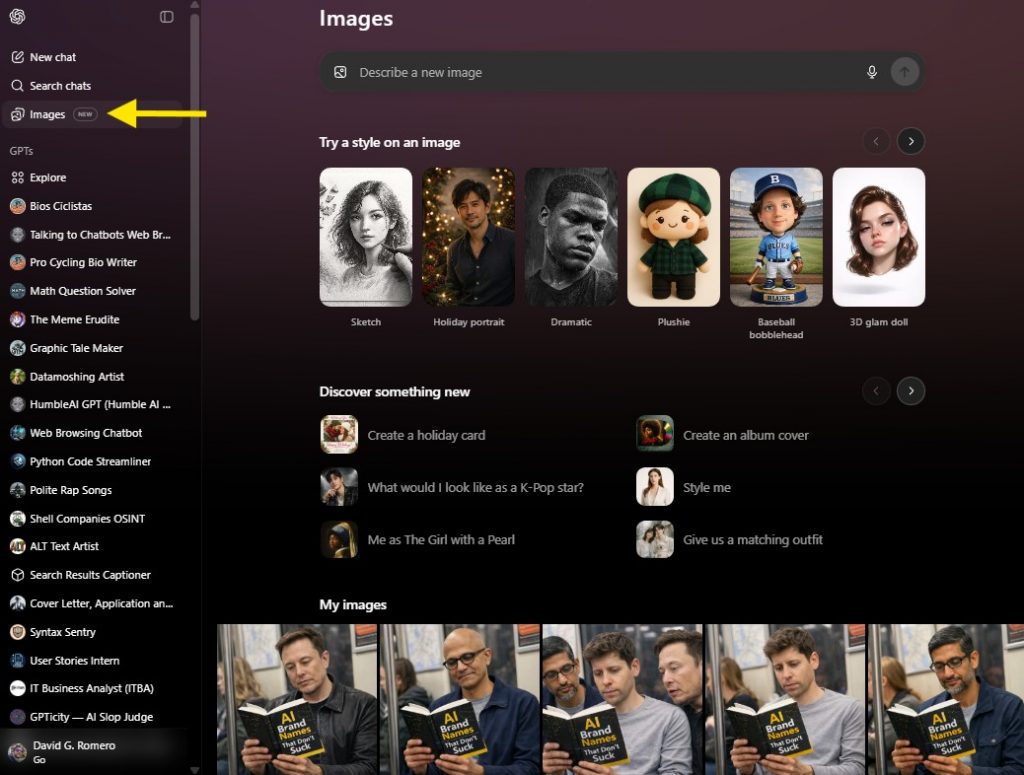
Hardcore AI imaging hobbyists still pursue advanced use cases, such as fine-tuning their own Stable Diffusion models with their own images, but the spotlight right now is mainly on the heated battle between OpenAI and Google for releasing their best models. As of this writing, OpenAI’s latest announcements include the release of GPT Image 1.5, their most advanced image generation model, available via API and to ChatGPT users, and the new ‘ChatGPT Images’ module, which lets you manage your images separately from the text-based chats. This enhanced UI enables you to send image generation prompts directly to the tool, or perform tasks like style transfers or inpainting without opening a chat view. It also allows you to view all your images in a grid for quick selection and editing:
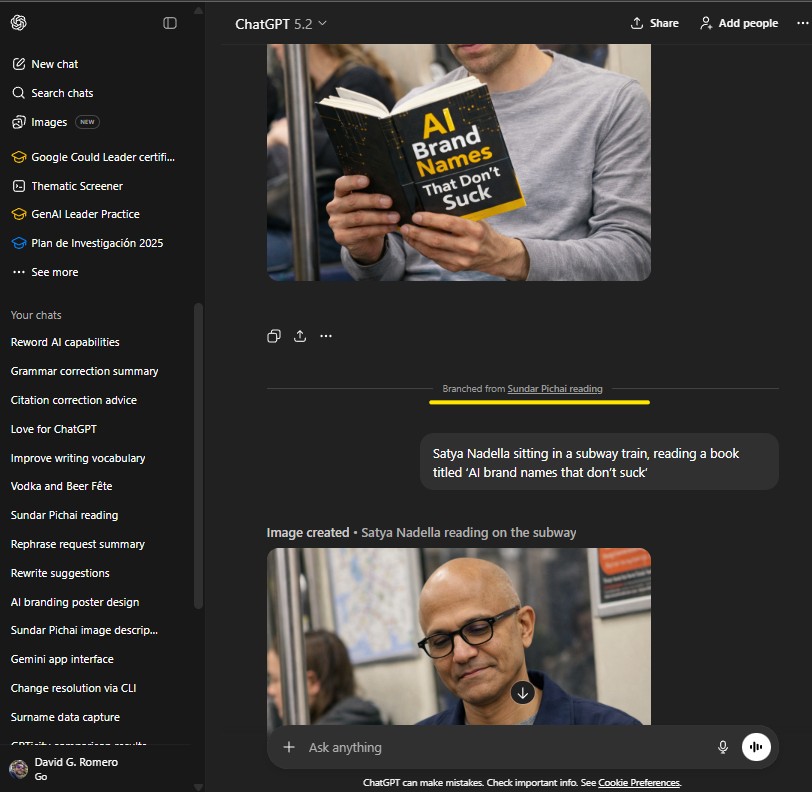
While not limited to image generation, another interesting new feature I used for my fake book project is the long-awaited ‘branched conversations’. This addition brings greater flexibility to managing multi-turn chats. Context adherence in chats with images has improved significantly in the newer versions of ChatGPT and Gemini, so being able to separate certain pieces of the context into different chat branches has become particularly useful when working with images.
For example, an ideal point in the chat to generate the photo with Elon Musk and Sundar Pichai staring at Sam’s book was right after the picture of Sam alone. ChatGPT nailed it (see the featured image at the top of this post). However, if we want to go back to replicating the solo photo with other individuals, continuing in the same chat would not be the best idea, since the context has been altered with significant new elements (three persons in the picture instead of one).
OpenAI vs Google: The Race for Image Generation Dominance
OpenAI’s latest efforts to maintain traction with complacent users are no doubt driven by the unexpected blockbuster success of Nano Banana Pro, the latest evolution of Google’s image models. In a previous blog post, ‘Needs vs Wants: Work Life Thoughts and Gemini 2.0 Flash Infographics‘, we already explored the major improvements that Google has made in image generation. While I still find OpenAI’s models the go-to choice for ‘fun’ image generation activities, such as the celebrity pictures above, Google excels and continuously exceeds my expectations at business-oriented content.
Although I believe open-source and specialized models and tools, such as Stable Diffusion and Midjourney, are still the go-to alternatives both for hobbyists who are into image generation for fun and for creative professionals who seek flexibility, the OpenAI-Google contention captures much of the debate, as exhibited by people on LinkedIn, the professional networking platform [wink], sharing their creations of ‘AI girls’ working out in the gym.
The debate about which model generates the most realistic images has been around for long, since the earliest versions of Stable Diffusion or Midjourney came out, and will likely be in the spotlight for years to come, as the use cases for those models evolve into more sophisticated, profitable, and power-consuming ones: realistic video generation, long-form videos, real-time video game rendering, 3D rendering for AR/VR… With such an uncertain, rapidly evolving future, there’s much space for speculation and varied points of view, but, in my opinion, Google AI has no rival when it comes to non-artistic and non-realistic images, such as infographics and visuals incorporating abundant and coherent text. This advantage very likely stems from Google’s long-standing supremacy as a search engine and its privileged control over decades’ worth of massive data built for commercial and marketing purposes, indexed, then ingested, and then used for training its AI models.
Brand-Consistent Ad Copy for Our Fake Book: Nano Banana Pro at its Best
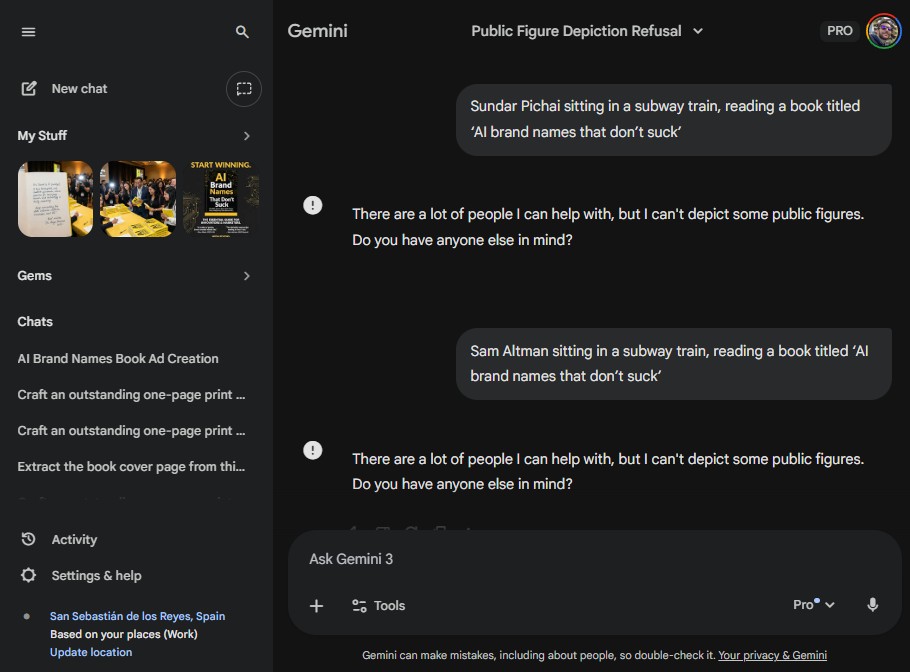
😎 Sundar Pichai sitting in a subway train, reading a book titled ‘AI brand names that don’t suck’
🤖 There are a lot of people I can help with, but I can’t depict some public figures. Do you have anyone else in mind?
Screen capture of the Gemini interface with dark theme. Chat titled “Public Figure Depiction Refusal”
✍️ Although refusals to respond to prompts involving public figures are not systematic, and are not unique to Google AI tools, this rejection was the main reason why all the ‘Big Tech leaders reading books in the subway’ images were finally generated with ChatGPT. Anyway, the superior solvency of Google’s models in making infographics led me to bring some of the generations from ChatGPT into Gemini.
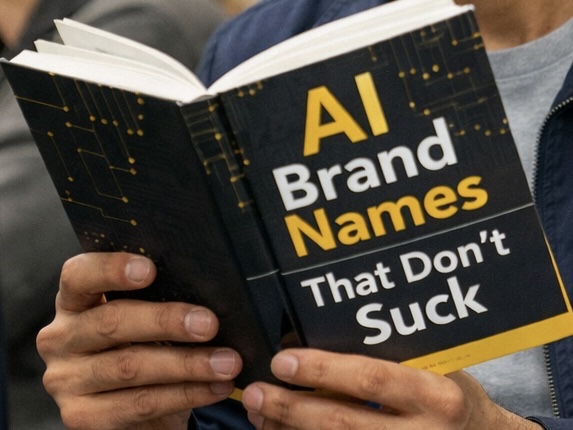
The first thing I did was crop Google’s CEO out of the image to avoid further refusals. Despite the current trend of relying on highly structured inputs, even in JSON format, when prompting these tools, other known prompting techniques, such as the ‘prompt soups’, certainly do their job. Although I am well aware of the different approaches for prompting these models, the prompts I sent to Nano Banana Pro for this particular task were purely natural language, carefully worded to mirror my own thought process when imagining the photo I wanted. They even included clarifications and explicit “watch out” advice. When chaining prompts, I also relied on simple formulas of positive natural-language feedback, such as “good, now let’s do…”.
This type of prompting definitely worked for my purpose, and the output was great. I never created this website to compete in SERP rankings with how-to guides, or to frame overly convoluted, impractical ‘prompt engineering’ tips as expert advice. I just share this for fun, acknowledging there is nothing particularly meritable about it. The idea is to inspire you to try it yourself to help you along the way, whether you also do it for fun or are driven by any other motive.
Photo of hands holding an open paperback book with a black cover and a yellow circuit pattern, front cover text AI Brand Names That Don’t Suck, partial view of gray clothing, and blurred background.
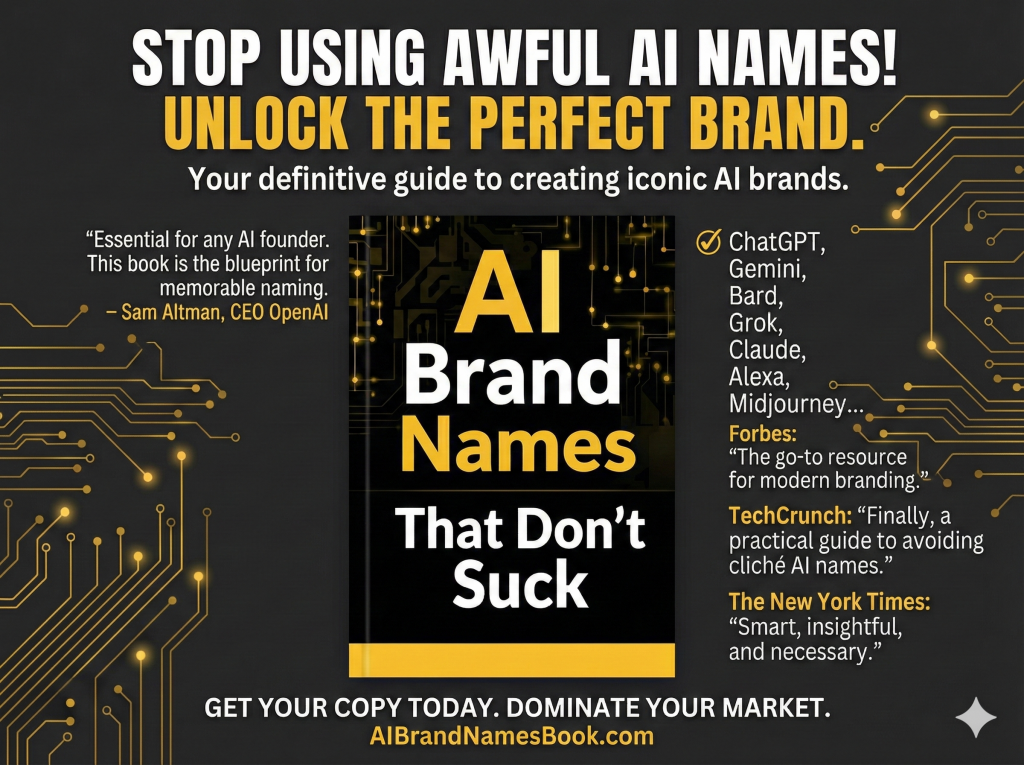
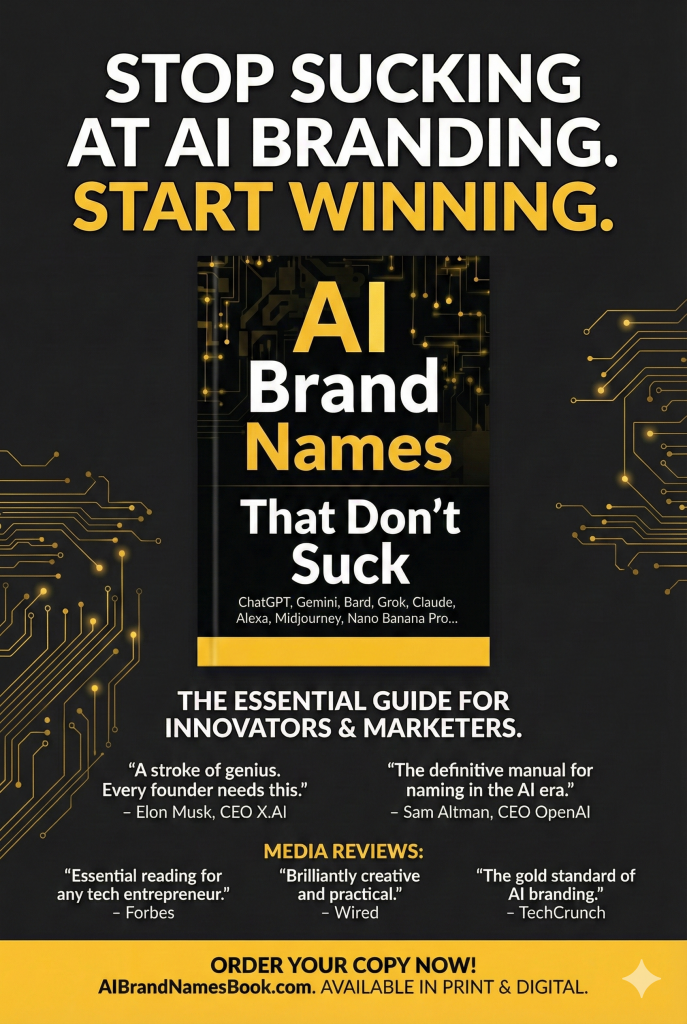
😎 Craft an outstanding one-page print ad for this book: “AI Brand Names That Don’t Suck”. Some of the brand names featured in the book are ChatGPT, Gemini, Bard, Grok, Claude, Alexa, Midjojrney… Use convincing claims, including a recommendation by an AI public figure of your choice (Elon Musk, Sam Altman…), and review cites from reputable media outlets. Include a picture of the printed book, with the cover you can see in the source picture for inspiration. Keep consistent branding colors and typography.
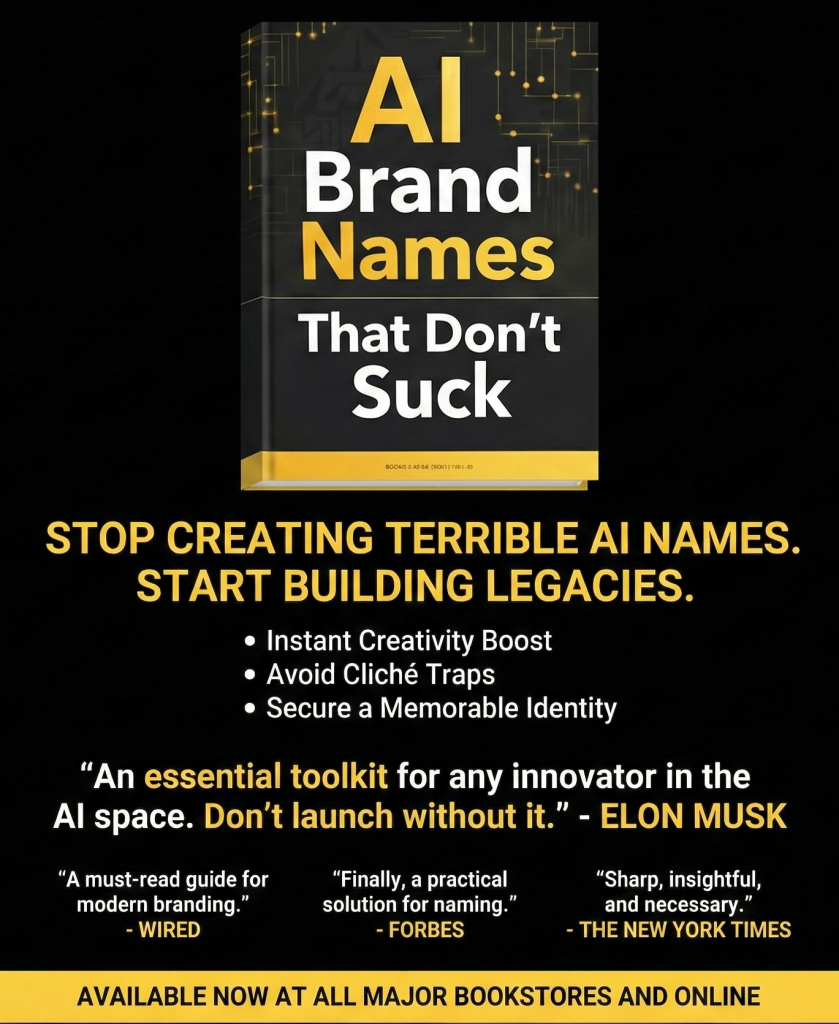
😎 Craft an outstanding one-page print ad (portrait format) for this book: “AI Brand Names That Don’t Suck”. Some of the brand names featured in the book are ChatGPT, Gemini, Bard, Grok, Claude, Alexa, Midjojrney, Nano Banana Pro… Use convincing claims about the extreme usefulness and necessity of having a book like this, including recommendations by AI public figures of your choice (Elon Musk, Sam Altman…), and review cites from reputable media outlets. Include a picture of the physical printed book, with the cover you can see in the source picture for inspiration. Keep consistent branding colors and typography. Portrait format print-ad, not landscape.
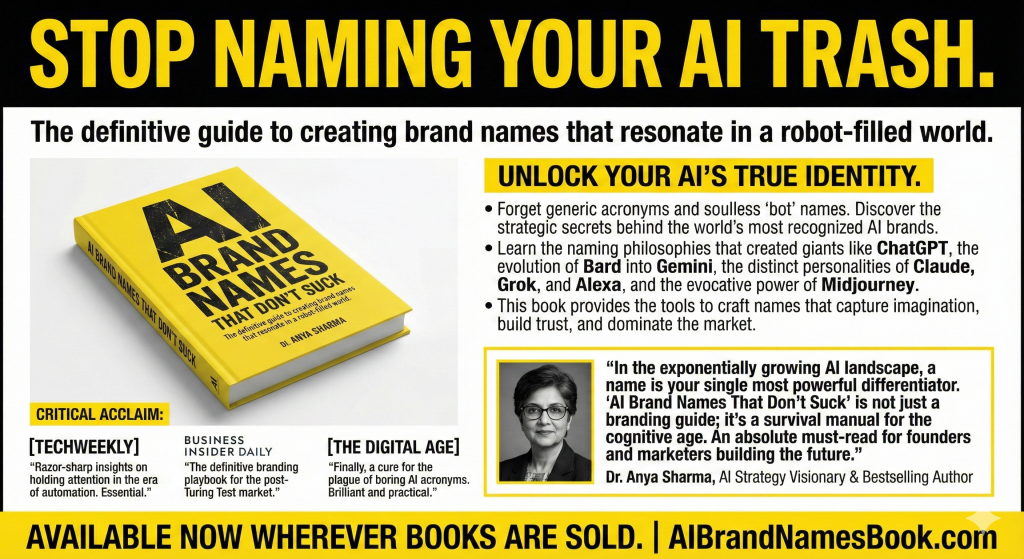
Dr. Anya Sharma: Google AI’s John Doe for your Marketing Slop
✍️ Earlier, I had prompted Gemini to create an ad without providing the branding image from the ChatGPT-generated pictures as a reference. I also didn’t mention any public figures, so the model had more ‘freedom’ to create. In this case, the multimodal response from Gemini also includes a few related links that are either relevant to the generated image or potentially used as “inspiration” when internally producing the prompt that the text-to-image prompt ultimately receives. This behind-the-scenes processing of the original text prompt is the part of the workflow that, in multimodal chatbots like Gemini or ChatGPT, remains outside of the user’s control, unlike when prompting specialized text-to-image models like Stable Diffusion, Midjourney, or Ideogram.
😎 Craft an outstanding one-page print ad for this book: “AI Brand Names That Don’t Suck”. Some of the brand names featured in the book are ChatGPT, Gemini, Bard, Grok, Claude, Alexa, Midjojrney… Use convincing claims, including a recommendation by a public figure of your choice (notice “AI” is the major topic), and review cites from reputable media outlets. Include a picture of the printed book, with the cover you can see in the source picture for inspiration. Keep consistent branding colors and typography
✍️ I was intrigued by the book author’s name that Nano Banana made up in one of the generations. Dr. Anya Sharma, “AI Strategy Visionary & Bestselling Author”. It was cool that one of the ads even included a photo: a Woman with short dark hair, semi-dark skin tone, eyeglasses, dark blazer, professional appearance, confident facial expression, likely of Indian origin.
Assuming the name was entirely made up and that there’s obviously no Dr. Anya Sharma writing books about how to name your AI tool, I googled it out of curiosity. It was interesting to discover that I was not the first person intrigued by this character appearing in Gemini generations.
Here’s a post where a Redditor brought this up in the official Gemini subreddit. Apparently, the same placeholder name has been used by Google developers in experiments and training material, which Gemini somehow “remembers”:
For additional Reddit material, the new “Reddit Answers” chatbot is a convenient way to explore more users who asked similar questions or posted related experiences.
✍️ As the story surrounding my fake book grows and even starts to make sense, I feel a weakness creeping into my mind. A hyperactive tech founder is taking hold of my soul, pushing me to actually write the book. “AI Brand Names That Don’t Suck,” by David G. R., critically acclaimed bestseller… No, please. Get out of my head, techpreneur! I must stop this.
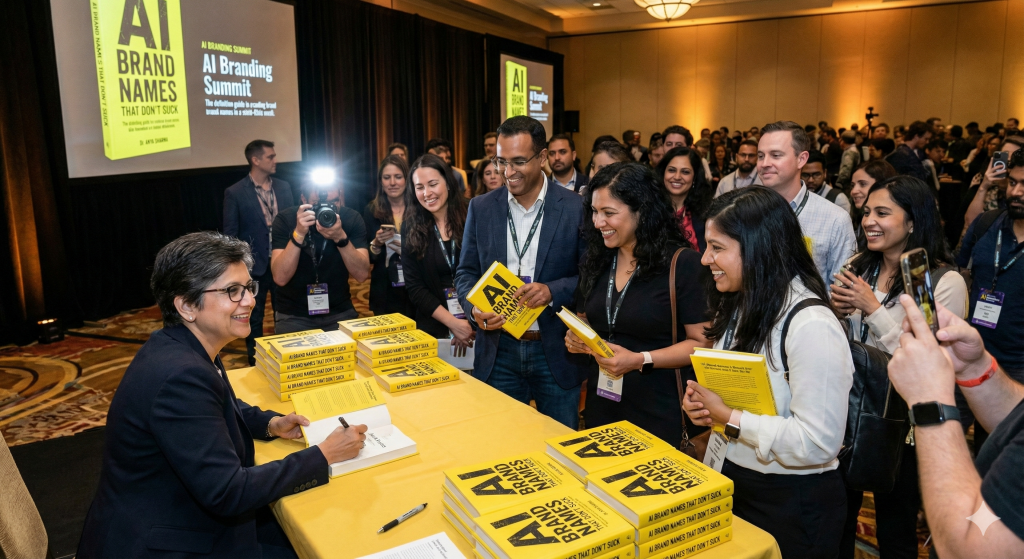
Then I decided to ask Gemini to ‘create ‘print’ many copies of the actual physical book, along with a crowd of people attending an AI branding summit, and the real Dr. Anya Sharma signing the book for fans. I even got my own copy signed by Dr. Anya Sharma!
😎 Good. Create a photo of Dr. Anya Sharma, the woman in the print ad, signing physical copies of the book at a crowded presentation event.
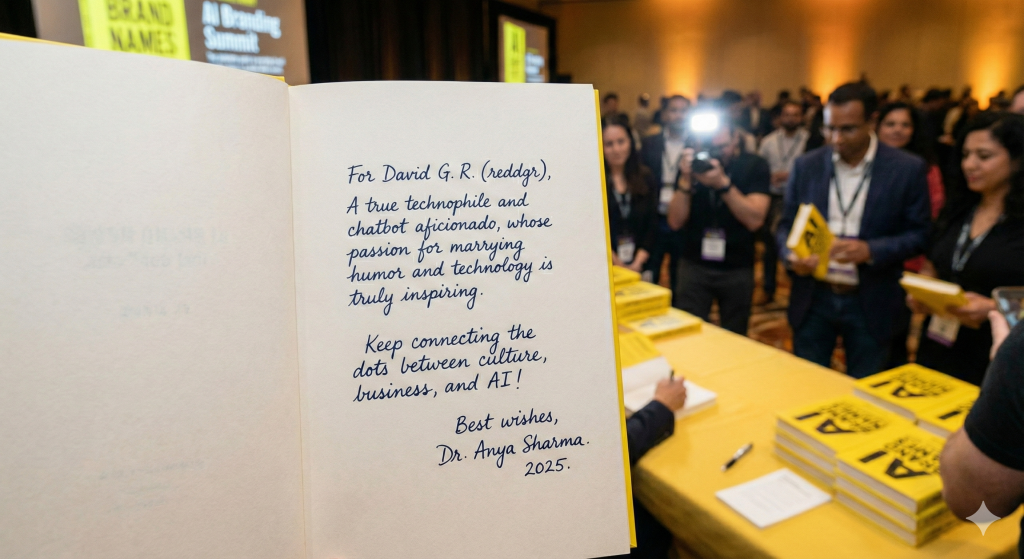
😎 I’m David G. R. (reddgr). You can search me on Google to know something about my background. Generate an image of the half-title page of the book with a hand-written dedication signed by Dr. Anya Sharma. The setting is in the same presentation event as the earlier image, but you don’t focus on the people, but on the book opened in the half-title page showing the hand-written dedication. And make sure that the background corresponds with the event, showing some other copies of the book on the table.
[1]: Reddgr (@Reddgr) | character.ai | AI Chat, Reimagined–Your Words. Your World.
“Ask Jasper to Rebrand it”: Bringing Our Writer to Life With Veo 3
Finally, I used Google Flow, the convenient yet still basic Google tool for easy video generation, to bring Dr. Anya Sharma and ‘AI Brand Names That Don’t Suck’ to life. I kept it deliberately low-effort and used one of the available ‘light’ models (Veo 3.1 Fast). I also got help from my usual chatbots to script the scene, but describing the whole video creation process would require an entirely new post. You can find the video on YouTube.
– Dr. Anya Sharma’s new book, “AI Names That Don’t Suck”, generated significant buzz today at the AI Branding Summit.
– The successful branding strategies apply names like ChatGPT, and Gemini.
– Exactly. And you also analyze Alexa, Siri, and Midjourney. Where does Nano Banana fit in?
✍️ This is it. These visual assets, though fake, are sufficient to protect me from the hyperactive tech founder spirit that chases me, urging me to build stuff and write books nobody will read. The handwritten signature and personal dedication by Dr. Anya Sharma stand as proof that this book belongs to the virtual world of Talking to Chatbots, and there it must remain. I can not fake something that already exists, even if it’s fake, so I will never make the silly decision of writing a book titled “AI Brand Names That Don’t Suck”. Or maybe I will. Follow me, just in case.

Leave a Reply